
Africa’s Next Trillion-Dollar Opportunity May Be Hiding in Agriculture
- Misheveve Journal
-
Sep 24
-
8 min read
- Share post
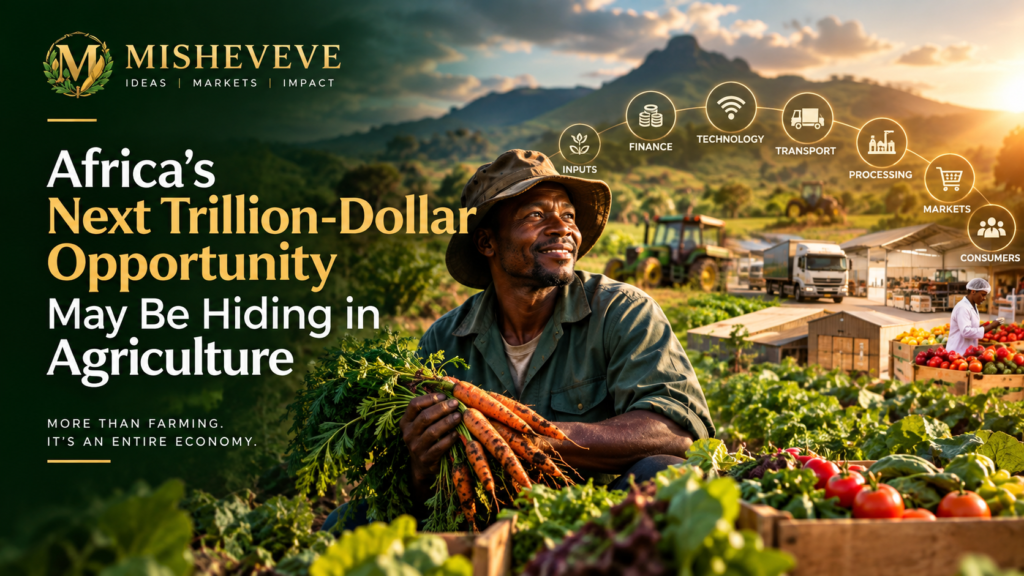
For decades, the conversation around African agriculture has largely revolved around one question: how much food can the continent produce? But as Africa’s population grows, cities expand and climate pressures intensify, that question is becoming too narrow. The bigger question is no longer simply how much Africa can grow, but how much economic value it can create from the food, livestock, land, water, technology and people already within its agricultural system.
Agriculture is gradually becoming something much bigger than farming. It is an ecosystem connecting farmers to finance, technology, energy, transportation, storage, processing, insurance, data and markets. A farmer planting maize is participating in a much larger economic chain that includes seed companies, fertilizer suppliers, financial institutions, transporters, warehouses, processors, retailers and consumers. The same is true for milk, coffee, tea, vegetables, goats, sheep, beef and virtually every agricultural product moving through the economy.
This shift is particularly important for Kenya. Agriculture remains deeply connected to the country’s economy and livelihoods, yet producers continue to face challenges ranging from unpredictable weather and limited access to finance to fragmented markets, inadequate storage and limited value addition. These challenges are often discussed as problems affecting farmers, but they are also signals of where new businesses and investment opportunities could emerge.
The opportunity may therefore not be simply to produce more. It may be to build better systems around production.
Consider something as ordinary as a tomato. A farmer grows it, a trader buys it and eventually a consumer purchases it. But between the farm and the consumer is an entire network of economic activity. Someone provides the seed. Someone finances production. Someone supplies irrigation equipment. Someone provides weather information. Someone transports the harvest. Someone stores or processes it. Someone provides the market where it is sold.
The tomato is only the beginning of the story.
This way of looking at agriculture opens the door to a different kind of entrepreneur. The next major agricultural company in Africa may not necessarily be the one that owns the largest farm. It could be the company that connects thousands of farmers to finance, technology, veterinary services, markets, logistics and processors.
Imagine a company working with 10,000 farmers across several counties. Instead of simply selling them inputs, it provides access to improved genetics or seed, digital records, agricultural extension, weather information, financing, insurance and organized markets. The company then aggregates production and connects farmers to processors, supermarkets, hotels or exporters. What began as a farming problem becomes a commercial network.
Livestock provides an especially interesting example. Kenya’s livestock economy extends far beyond the individual farmer raising cattle, goats, sheep or poultry. Behind every animal are questions of genetics, breeding, feed, veterinary care, financing, transportation, aggregation, slaughter, processing, retail and consumption. The World Bank has highlighted livestock as an important economic sector in Kenya and examined how private investment can reshape the sector.
This means that the opportunity in livestock may not simply be to own more animals. It may be to create a more organized livestock economy. A breeding company can improve genetics. A technology company can create digital animal records. A veterinary network can improve animal health. An aggregator can connect dispersed farmers to large buyers. A processor can turn livestock into higher-value products. Each part of the chain represents a potential business.
Water presents another enormous opportunity. Agriculture cannot escape the realities of climate variability. When rainfall becomes unpredictable, agricultural production becomes unpredictable as well. This creates demand for irrigation, water harvesting, storage, solar-powered pumping, precision irrigation and technologies that help farmers use water more efficiently.
The question is increasingly becoming whether agriculture can be designed so that a farmer’s livelihood is less dependent on the timing and reliability of rainfall. Climate-smart agriculture is built around this kind of thinking. The World Bank describes climate-smart agriculture through three broad objectives: increasing productivity, strengthening resilience and reducing greenhouse-gas emissions where possible.
That makes climate adaptation more than an environmental issue. It becomes an economic opportunity.
There is also another major opportunity hiding in plain sight: value addition. Africa can produce agricultural commodities without necessarily capturing the full economic value associated with them. A farmer selling raw milk is participating in one market. A company turning that milk into yoghurt, cheese or another processed product is participating in another. A farmer selling mangoes is part of one value chain. A company processing those mangoes into juice, dried fruit or other products occupies a different position in the economy.
The closer agricultural production moves toward processing, branding, packaging and distribution, the more opportunities emerge for jobs, businesses and local investment.
Food loss creates another layer of opportunity. Food can be produced successfully and still lose value because of poor storage, inadequate transportation, limited refrigeration, weak aggregation or delayed access to markets. Solving these problems does not necessarily require producing another kilogram of food. Sometimes it requires ensuring that the kilogram already produced actually reaches the consumer.
That is why cold-chain businesses, warehouses, agricultural logistics companies, aggregation centres and food-processing facilities should increasingly be viewed as part of agricultural infrastructure.
Then there is data.
Agriculture generates enormous amounts of information, but much of it remains fragmented. Imagine having reliable information about where farmers are located, what they are producing, expected harvest volumes, weather conditions, disease risks, market prices and buyer demand. Such information could change how farmers, banks, insurers, processors, traders and governments make decisions.
A bank could potentially understand a farmer’s production history better. A processor could anticipate how much raw material will be available. A farmer could make decisions using better market and weather information. An insurer could better understand agricultural risks. An investor could identify emerging opportunities.
This is where agriculture begins to merge with artificial intelligence, financial technology, telecommunications and data science.
The growing attention from development finance institutions is significant. The World Bank’s agricultural work increasingly emphasizes productivity, climate resilience, value chains, technology, food systems and private-sector participation. Its recent initiatives in Africa have also placed emphasis on mobilizing private capital and supporting agribusiness and agricultural technology.
This matters because development finance is not only about building individual farms. Large development projects tend to look at broader outcomes such as farmer incomes, productivity, food security, employment, climate resilience, market access and private investment.
That changes how an agricultural entrepreneur should think.
A farm producing hundreds of goats is a business. But a company creating a system that helps thousands of farmers produce, manage, aggregate and sell goats can potentially create a much wider economic impact. The farm becomes one component of the system rather than the entire system.
Kenya’s opportunity, therefore, may lie in building agricultural systems rather than simply increasing agricultural production.
Instead of asking only what crop should be planted, the country can ask what agricultural systems need to be built. Instead of asking how many farmers exist, it can ask how efficiently those farmers participate in markets. Instead of asking how much food is produced, it can ask how much value is captured from every kilogram produced.
And instead of asking where agricultural funding can be found, entrepreneurs can ask a more fundamental question: what agricultural problem is large enough, measurable enough and commercially sustainable enough to attract serious capital?
That question leads agriculture into the territory of infrastructure, technology, manufacturing, finance, logistics, trade and investment.
Yet the farmer must remain at the centre of this transformation. A sophisticated agricultural platform means little if the farmer remains the weakest participant in the system. Technology should solve real problems rather than simply add another cost. Finance should expand productive opportunities rather than deepen vulnerability. Aggregation should create stronger market access rather than simply introduce another intermediary.
The ultimate test of agricultural transformation is whether the people producing food can become more productive, more resilient and better connected to growing markets.
Africa’s next agricultural revolution may therefore not be defined by one miracle crop or one revolutionary machine. It may emerge from thousands of businesses solving different parts of the same enormous system.
A solar-powered irrigation company in a dry county. A digital platform connecting farmers with buyers. A cold-storage facility reducing post-harvest losses. A breeding centre improving livestock genetics. An insurance company protecting farmers from climate shocks. A processing plant transforming raw commodities into consumer products. A logistics company moving food efficiently across borders. An investment fund financing businesses across the value chain.
Individually, these may look like separate opportunities. Together, they form something much larger: an emerging African food economy.
The future of African agriculture will not simply be about who grows the food. It will increasingly be about who builds the systems that allow Africa to produce, finance, process, transport, sell and capture more value from that food.
And somewhere inside that enormous system lies a new generation of African businesses waiting to be built.

