
Yacon Apple
- Misheveve Journal
-
Sep 21
-
7 min read
- Share post
Yacon Apple: The Plant That Is Changing Lives
The unusual root crop attracting attention from farmers, food innovators and consumers looking for something different.
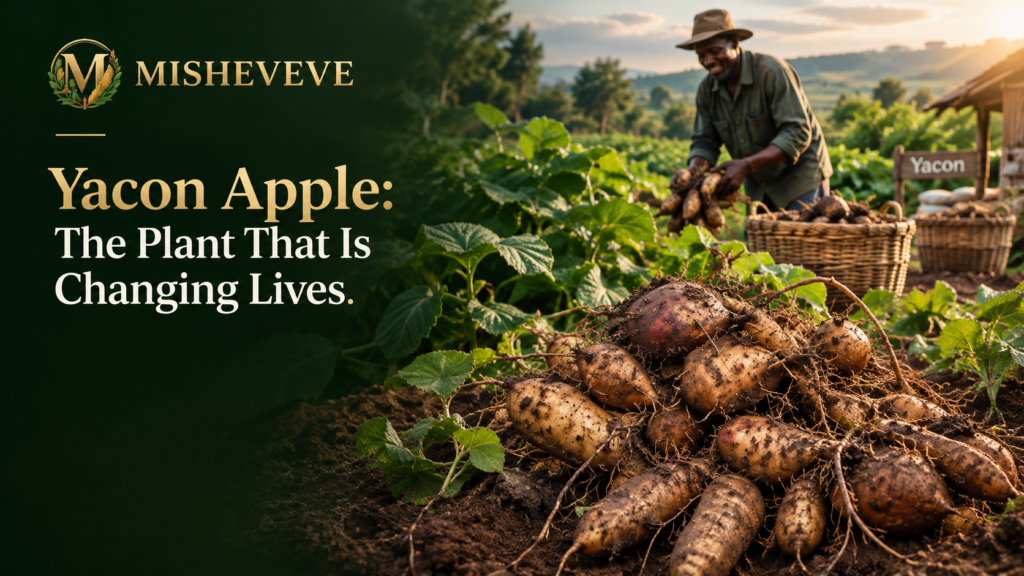
There is a plant that can easily be overlooked when you first see it growing in a field. Its broad green leaves do not immediately reveal what is happening beneath the soil. But dig a little deeper and you may discover something quite different from the familiar root crops found on many farms. This is yacon, sometimes called the yacon apple because of the crisp, juicy texture and naturally sweet taste of its edible tubers.
Yacon, scientifically known as Smallanthus sonchifolius, originates from the Andean region of South America. Today, its unusual characteristics have attracted interest beyond its traditional growing regions, including among people exploring alternative crops, specialty foods and agricultural value chains. For Kenyan farmers, yacon presents an interesting question: could an unfamiliar crop become another opportunity for farm diversification?
The growing interest in yacon is not simply because it is different. Its underground tubers contain naturally occurring fructooligosaccharides, commonly known as FOS, which are a type of carbohydrate and prebiotic dietary fibre. This characteristic has contributed to interest in yacon among researchers, food developers and consumers interested in functional foods.
That nutritional interest, however, should not be confused with medical claims. Yacon is a food crop, not a miracle cure. Claims that it can treat or cure diseases should be approached carefully. Its nutritional characteristics are what make it interesting, while a person’s overall diet and individual circumstances remain important when considering health.
For farmers, the bigger story may actually be somewhere else.
It may be in diversification.
Agriculture is changing rapidly. Consumers are discovering new foods, businesses are searching for distinctive ingredients, and farmers are looking for ways to participate in emerging markets. This is creating interest in crops that may have been unfamiliar to the mainstream agricultural market.
Yacon fits naturally into this conversation.
A farmer does not necessarily need to abandon traditional crops to explore an alternative crop. In some situations, introducing a new crop on a small scale can become part of a broader farm diversification strategy. The important thing is understanding whether the crop fits the farm, the farmer and the market.
And that starts with the land.
Yacon production requires farmers to understand the crop’s growing conditions, soil requirements, moisture needs, planting material, spacing, weed management and harvesting practices. Conditions can vary significantly from one location to another, so farmers should not assume that successful production in one region automatically means identical results elsewhere.
This is particularly important for crops that are still relatively unfamiliar.
Before putting significant acreage under yacon, a farmer can begin by learning how the crop performs locally. Small trials can provide valuable practical information about establishment, growth, tuber development, harvesting and post-harvest handling. Agricultural professionals and experienced growers can also provide useful guidance on local production practices.
But there is another question that may be even more important than how well the plant grows.
Who is going to buy it?
This is where the difference between farming and agribusiness becomes clear.
Growing a crop is only one part of the agricultural value chain. A commercially viable enterprise also requires a market, suitable pricing, consistent quality, transportation and, where appropriate, processing and packaging.
A farmer can produce an impressive harvest and still struggle if there is no reliable market.
For yacon, potential opportunities could exist across fresh produce, specialty foods and value-added products. Depending on market demand, yacon can be explored in fresh form or as an ingredient for processed food products. Yacon-based products have also attracted interest in areas such as syrups and other food applications.
However, the opportunity should be investigated rather than assumed.
A farmer considering yacon should speak with potential buyers, understand their requirements and determine what form of product they actually want. A retailer may want clean, fresh tubers. A processor may require specific quality characteristics or volumes. A food business may be interested in a processed ingredient rather than the raw crop.
The market determines the opportunity.
This is also where value addition can change the story.
Imagine a farmer harvesting yacon and selling it immediately at the farm gate. Now imagine another business purchasing yacon from several farmers, cleaning and grading the tubers, developing a processed food product, packaging it professionally and connecting it with consumers.
The crop is the same.
The value chain is different.
That difference can create opportunities for farmers, aggregators, processors, packaging companies, distributors, retailers and young agricultural entrepreneurs.
This is one reason emerging crops deserve attention beyond the farm.
Young people entering agriculture do not necessarily have to limit themselves to planting and harvesting. The agricultural economy also needs people who can aggregate produce, build brands, develop products, manage logistics, create digital marketplaces, connect farmers with buyers and develop new consumer experiences.
Yacon could therefore become more than a crop.
It could become part of a wider agricultural ecosystem.
But every opportunity comes with questions.
Farmers should consider the cost of planting material, labour, land preparation, water, crop management, harvesting, packaging and transportation. They should also consider the availability and reliability of planting material. Starting with a small production area can help reduce exposure while the farmer learns about the crop and tests the market.
The economics should be clear before expansion.
A crop being described as “high value” does not automatically mean it is highly profitable. Profit depends on the relationship between production costs, yields, selling prices, market access and losses along the value chain.
This is a lesson worth remembering whenever a new agricultural crop begins trending.
Do not plant because everyone is talking about it. Plant because you understand the opportunity.
Yacon is particularly interesting because it challenges the way we think about agricultural products. What looks like an ordinary leafy plant above the ground can contain an entirely different opportunity below it.
And perhaps that is the bigger lesson.
Agriculture is not always about discovering something that has never existed before. Sometimes it is about discovering the potential of something that has existed for generations but has not yet found its place in a new market.
Kenyan agriculture has enormous diversity, from food crops and livestock to horticulture, specialty produce and emerging value chains. Exploring alternative crops can add another dimension to that diversity when farmers have the right information and market knowledge.
Yacon’s story is therefore not simply about a sweet root.
It is about curiosity, diversification, nutrition, innovation and value addition.
It is about asking whether farmers can look beyond familiar crops and explore products that serve changing consumer interests.
It is about connecting the farm to the processor, the processor to the retailer and the retailer to the consumer.
Most importantly, it is about making informed agricultural decisions.
Yacon may not yet be a household name in Kenya, and that means there is still much to learn about its production, consumer awareness, market development and commercial potential in different parts of the country. That uncertainty is precisely why research, small-scale trials and market testing matter.
For farmers who are willing to explore, however, yacon represents an intriguing possibility.
A crop can start with a seed, a cutting or a small planting trial. But a successful agricultural enterprise starts with something else: an understanding of the opportunity.
So the next time you see a field of unfamiliar green plants, remember that the most interesting part may not always be what you can see.
Sometimes, the next opportunity in agriculture is hiding beneath the soil.
