
Herbs Kenyan Farmers Can Consider
- Misheveve Journal
-
Sep 21
-
6 min read
- Share post
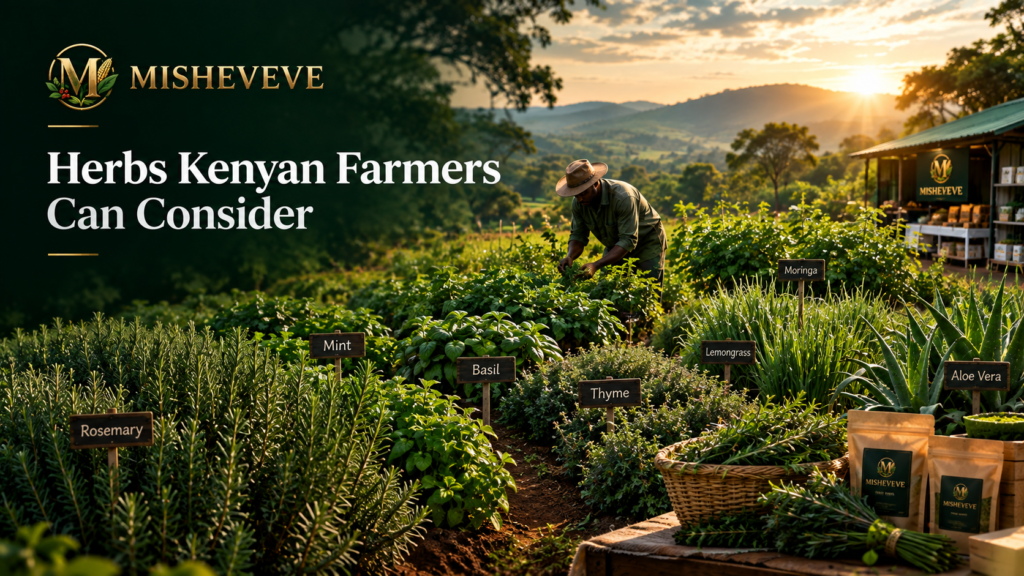
Herbs Kenyan Farmers Can Consider: A Practical Guide to Herbal Farming
Kenya’s agricultural landscape is changing. Farmers are increasingly looking beyond traditional crops and exploring herbs, medicinal plants, and high-value horticultural products that can serve growing local and regional markets.
But herbal farming is not simply about planting a few herbs and waiting for a good price. The right crop depends on climate, soil, water availability, production costs, market demand, quality standards, and the intended use of the herb.
For farmers considering diversification, here are some herbs and herbal crops worth exploring.
1. Moringa
Moringa is one of the better-known multipurpose plants in African agriculture. Its leaves and seeds have attracted attention from food, wellness, cosmetic, and processing businesses.
Farmers can explore opportunities in fresh leaves, dried leaves, powder, seeds, and other value-added products, depending on market requirements.
Moringa can therefore be considered not only as a crop but as part of a wider value-addition opportunity.
However, farmers should research their target market before planting on a large scale. Demand for a crop does not automatically mean every farmer will find a profitable market.
2. Aloe Vera
Aloe vera is widely associated with cosmetic, personal-care, and wellness products. Its ability to grow in relatively dry conditions also makes it interesting for farmers in suitable areas.
Potential markets may include processors and businesses using aloe in cosmetics, personal-care products, and other processed applications.
Farmers considering aloe vera should investigate the availability of buyers, contractual arrangements, processing requirements, and transportation costs before establishing a commercial plantation.
3. Rosemary
Rosemary is an aromatic herb that can serve both culinary and commercial markets.
It can be sold as a fresh herb or dried product, while its aromatic properties also create opportunities in food processing, seasoning, and other applications.
For smaller farmers, rosemary may offer an interesting diversification option where there is reliable market access and suitable growing conditions.
The important question is not simply “Can rosemary grow here?” but “Who will buy it, in what form, and at what volume?”
4. Mint
Mint is another herb farmers can consider, particularly where there is access to water and markets that require fresh herbs.
Fresh mint can be used in households, restaurants, hospitality businesses, food preparation, beverages, and processing.
Because fresh herbs are perishable, however, market distance, harvesting practices, packaging, storage, and transportation can have a major effect on the business.
This makes mint particularly interesting for farmers located close to urban markets and organized buyers.
5. Lemongrass
Lemongrass is valued for its distinctive aroma and has applications in food, beverages, personal-care products, and other processed products.
Farmers can explore opportunities in fresh lemongrass, dried products, and potential processing markets.
Its commercial potential becomes more interesting when farmers understand the entire value chain—from production and harvesting to drying, packaging, processing, and distribution.
6. Basil
Basil is a popular culinary herb with opportunities in fresh-food markets, restaurants, hospitality, food processing, and specialty produce.
For farmers near major towns and cities, growing herbs such as basil can provide an opportunity to supply restaurants, hotels, retailers, households, and other food businesses.
The crop may be particularly suitable for farmers who can produce consistently and meet buyer expectations for freshness and quality.
7. Thyme
Thyme is another aromatic culinary herb that can be explored as a niche agricultural product.
It can be marketed fresh or dried and may serve consumers and businesses looking for herbs for cooking, seasoning, and food preparation.
As with other specialty herbs, farmers should first identify the market rather than planting based solely on the assumption that a high-value crop will automatically generate high returns.
8. Lavender
Lavender has attracted interest because of its distinctive aroma and applications across personal care, cosmetics, fragrance, wellness, and other value-added products.
Its suitability, however, depends heavily on local growing conditions and access to a market.
Farmers interested in lavender should therefore consider climate suitability, production requirements, harvesting, processing, and buyer availability before making a significant investment.
Herbal Farming Is More Than Growing the Crop
One of the biggest opportunities in herbal farming may not be the raw herb itself.
It can be the value chain surrounding the crop.
A farmer could potentially move from:
Growing → Harvesting → Sorting → Drying → Packaging → Processing → Selling
This is where agricultural value addition becomes important.
Instead of selling only fresh produce at the farm gate, farmers and agricultural businesses can explore opportunities to supply dried herbs, packaged culinary herbs, herbal ingredients, and other products, provided they meet applicable quality, safety, labeling, and regulatory requirements.
Choosing the Right Herb for Your Farm
There is no single herb that is automatically the best choice for every Kenyan farmer.
Before planting, consider these five questions:
1. Does it suit your area?
Consider climate, rainfall, soil type, temperatures, altitude, and water availability.
2. Who is the buyer?
Identify potential buyers before expanding production. These could include processors, retailers, restaurants, hotels, wholesalers, exporters, or direct consumers.
3. What form does the market need?
A buyer may want fresh leaves, dried herbs, cleaned produce, powder, seeds, or another processed form.
Understanding this early can influence your production and post-harvest decisions.
4. What will production cost?
Calculate the costs of land preparation, seedlings or planting material, labour, irrigation, fertilizers or soil amendments, pest management, harvesting, drying, packaging, transport, and marketing.
5. Can you produce consistently?
Commercial buyers often need reliable quantities and consistent quality. A farmer who can produce a good product once may still struggle if they cannot maintain supply.
Start With the Market, Not Just the Seed
Herbal farming can look attractive when viewed from the perspective of crop prices or growing consumer interest.
But successful agribusiness requires more than identifying a potentially valuable crop.
Market first. Crop second.
Talk to potential buyers. Understand their specifications. Compare production costs. Research your local conditions. Start at a manageable scale and use the experience to determine whether expansion makes sense.
For farmers, cooperatives, youth agribusiness groups, and agricultural entrepreneurs, herbs can become part of a broader strategy for farm diversification and value addition.
The Bigger Opportunity in Herbal Farming
Kenya has a diverse agricultural sector, and farmers are continually looking for ways to respond to changing consumer preferences and market opportunities.
Herbs such as moringa, aloe vera, rosemary, mint, lemongrass, basil, thyme, and lavender represent different possibilities across food, wellness, cosmetics, personal care, and processing value chains.
But the opportunity is not simply in growing more herbs.
It is in understanding what the market wants, producing to the required quality, reducing post-harvest losses, adding value where practical, and connecting farmers to reliable markets.
That is where herbal farming can move from being an interesting crop idea to a structured agribusiness opportunity.
Final Thought
The next successful herb farmer may not simply be the person who grows the most—it may be the farmer who understands the entire value chain.
Before putting more land under herbs, ask yourself:
What am I growing, who needs it, what quality do they require, and how will I get it from my farm to the customer?
Those answers could determine whether your herbal farming project remains a small farm activity or grows into a sustainable agricultural business.
