
From Farm to Market
- Misheveve Journal
-
Sep 21
-
5 min read
- Share post
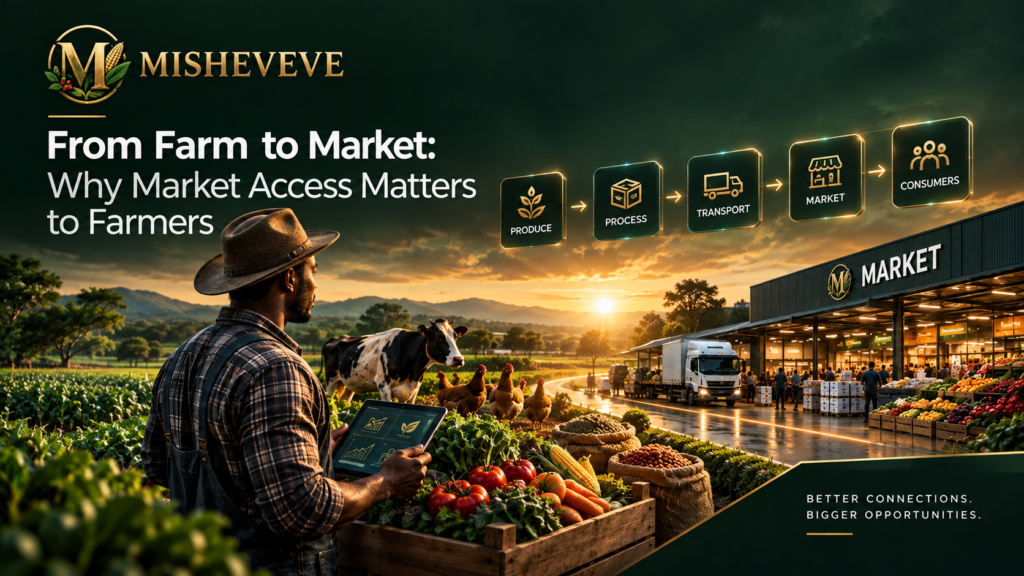
From Farm to Market: Why Market Access Matters to Farmers
Farming starts on the farm, but the opportunity does not end there.
A farmer can produce healthy vegetables, raise quality livestock, keep productive poultry, or harvest a good crop, but there is still one important question: Who is going to buy it?
That is where market access becomes important.
For many farmers, producing agricultural products is only one part of the journey. Finding reliable buyers, understanding demand, getting fair value, reducing post-harvest losses, and moving products to the right market can be just as important as production itself.
It Starts With Understanding the Market
Before putting seeds in the ground or investing in livestock and poultry, it helps to understand what the market actually wants.
What products are people looking for? When is demand highest? What quality do buyers expect? What quantities are required? Where are the buyers located?
These questions can help farmers make more informed production decisions.
Instead of simply asking, “What can I produce?”, farmers and agribusinesses can also ask, “What does the market need?”
That small change in thinking can influence everything from crop selection and production volumes to harvesting, packaging, pricing, and distribution.
Production Is Only Part of the Story
Agriculture is a value chain.
A product may begin with a farmer, but it can pass through several stages before reaching the final consumer. Seeds, fertilizers, animal feed, equipment, farming services, production, aggregation, transportation, processing, packaging, distribution, and retail can all play a role.
This means agricultural opportunities are not limited to farming alone.
There are opportunities across the wider agricultural value chain for suppliers, processors, transporters, retailers, technology providers, agribusinesses, and other businesses supporting food and agricultural production.
Quality Matters
Markets do not only look for agricultural products. They also look for quality, consistency, reliability, and value.
For a farmer selling vegetables, this may mean producing clean, fresh, properly handled produce. For a poultry farmer, it could involve consistent production and good farm management. For livestock producers, animal health, weight, quality, and reliability can influence buyer interest.
Good agricultural practices can therefore contribute to better market opportunities.
And sometimes, improving the way a product is handled, packaged, stored, or presented can make a meaningful difference.
What Happens When There Is No Ready Market?
This is one of the challenges farmers often face.
A farmer may have a successful harvest but struggle to find buyers at the right time. Perishable products can lose value quickly, while oversupply can place downward pressure on prices.
This is why market information and planning matter.
Knowing potential buyers, understanding seasonal demand, exploring different sales channels, and planning production around market opportunities can help farmers make better-informed decisions.
It does not eliminate market risks, but it can make the journey more deliberate.
Value Addition Creates More Possibilities
Sometimes the answer is not simply selling more raw agricultural products.
Value addition can create another path.
Milk can become yoghurt or other dairy products. Fruits can be processed into juices, dried products, jams, or other products. Grains can be milled and packaged. Agricultural produce can be cleaned, sorted, graded, packaged, preserved, or processed for different markets.
Processing can create additional business opportunities while potentially extending shelf life and improving product presentation.
The important question becomes:
How can we create more value from what we already produce?
Technology Is Changing the Conversation
Technology is also changing how farmers and agricultural businesses discover information, products, suppliers, buyers, and opportunities.
Digital platforms can make it easier to discover farm inputs, agricultural products, equipment, suppliers, markets, and services.
For farmers, this can mean spending less time searching and more time making informed decisions. For agricultural businesses, it can create another way to showcase products and reach potential customers.
This is where platforms such as Misheveve can play a role in making agricultural opportunities more visible and easier to discover.
Agriculture Is Bigger Than the Farm
When we talk about agriculture, it is easy to picture a farm, crops, livestock, or poultry.
But agriculture is much bigger than that.
It includes the inputs that support production, the farmers who produce, the businesses that process, the people who transport, the markets that connect supply and demand, and the consumers who ultimately use the products.
Every part of this chain matters.
And when these connections become easier to discover, understand, and navigate, new opportunities can emerge.
So, Where Do We Go From Here?
There is no single formula for successful farming or agribusiness.
Every farmer operates in a different environment. Every crop has its own requirements. Every livestock enterprise has different considerations. Markets change, consumer preferences change, and agricultural opportunities continue to evolve.
But one thing remains important: understanding the market and building connections around it.
At Misheveve, we believe discovering an agricultural opportunity should be easier.
Whether you are looking for farm inputs, agricultural products, processed products, farming opportunities, suppliers, or market information, the journey starts with discovery.
Because agriculture is not just about what we produce.
It is also about where it goes, who needs it, and the opportunities created along the way.
That is the conversation we want to keep having.
Welcome to Misheveve Journals — let’s talk agriculture.

